Sunday, February 04, 2007

Review - Christian Dress & Adornment

"Even those who disagree with some of the author's positions will find CHRISTIAN DRESS AND ADORNMENT worth reading..."

Book Description
"In CHRISTIAN DRESS AND ADORNMENT Samuele Bacchiocchi reminds us that while clothes do not make a Christian, Christians do reveal their identity through their clothes and appearance. The Bible does not prescribe a standardized dress for Christian men and *women, but it calls us to follow the simplicity and unpretentiousness of **Jesus’ lifestyle, even in our clothes and appearance. The Christian priority is not the external decoration of the body with costly clothes and ornaments, but the internal beautification of the soul with the love of Christ.

This book examines the Biblical teachings regarding dress, cosmetics, and ornaments. Seven basic principles regarding dress and adornment are developed from a careful analysis of the relevant Biblical passages. [One] chapter address the specific question of the unisex fashion promoted today. Christian Dress and Adornment is an important book designed to help Christians distinguish between the capricious mode that changes and the sensible style that remains." … Amazon Review

Purchase Christian Dress & Adornment from Amazon.

*The author avoids the discussion of requisite headcoverings for women (1 Cor 11:1-16) and the proscription of headcoverings for men while praying.

**Jesus’ lifestyle may have been simple, but His robe was of such high quality that Roman soldiers chose to cast lots for the privilege of having the entire robe, instead of ripping the fabric to share (John 19:23-24).

Saturday, February 03, 2007

How does one escape the world?

It’s hard to become engaged in politics and not become part of the world. It’s pretty hard to follow the dictates of fashion and not be a part of the world. It’s even harder to keep up with the Joneses and not be part of the world. And it’s pretty hard to keep the holidays of the world without becoming enmeshed in worldly things.

In the democratic West it is an implied part of good citizenship to vote and to volunteer on committees, for school and all of the other places where civil government is formed. Yet, if one is to come out of the world, one gives up allegiances to all and becomes devoted to the kingdom of God.

If you are not at the mercy of the latest fashion whim, one will dress modestly, not adorning oneself with jewels and costly array. One will begin looking like a plain dresser who is not one step behind the fashion police but lives separated from the dictates of fashion. Clothing now serves a functional place of both identifying gender as well as covering the body, keeping it warm in the winter and cool in the summer.

If one is not concerned with what the neighbors have or the car they drive or the toys they possess, then one becomes truly independent and liberated from bondage to the expectations of society. Why does a person need a half-acre of mown grass for a front yard and the riding mower required for its maintenance—why not a half acre of blueberries or whatever the property owner desires? The dictates of fashion and cultural expectations restricts the freedoms of a person and changes liberty into servitude.

Why celebrate the holidays of this world if one wants to come out of the world? Why succumb to the shopping madness that causes half of all retail sales to occur in the weeks before Christmas? Why do one's major shopping on the Sabbath--if a person really wants to come out of the world, why not keep the Sabbath? But that might be asking too much of even those who profess to desire to come out of the world. If a person wants to truly come out of the world a person will give up all of those things that originate in implied and unstated social obligations made to the prince of this world.

Yet to be a witness and a light to neighbors, near and far, adherence to certain social conventions are necessary. A person cannot reek of BO and produce any favorable impression. A person cannot look as if she were a troll living under the nearest bridge and be a positive witness for Christ. So escaping isn’t possible—all that remains possible is exercising control over the freedom extended by being called out of the world. Exercising this freedom comes with the price of being a reliable witness for Christ who lived as an Observant Jew. Freedom from bondage to disobedience does not mean freedom from the law. Too many who desire to leave the world keep one foot in it by maintaining the shackles of disobedience.

By faith I keep the laws of God to the best of my ability. I keep the Sabbaths of God and the principles of clean and unclean meats to the best of my ability. I try to keep in the forefront of my mind “But he [is] a Jew, which is one inwardly; and circumcision [is that] of the heart, in the spirit, [and] not in the letter; whose praise [is] not of men, but of God (Rom 2:29)." My modest dress is moving towards plain as plain dressers’ obedience should begin to encompass obedience to all of the laws of God, not just nine of them.

Sunday, January 28, 2007

Making a Covering


As I sit here in my little warm office, listening to WETA classical radio on NPR via my computer with streaming audio, I am so thankful for modern conveniences. I have a soft chair and lots of light and I can toggle my computer screen to play a series of photos gleaned from the web of Amish and Mennonite and other covering women, of reenactors in 18thC costume and French or Nouvelle France situations and I am going back in time. … Hand stitching instead of sewing by machine, using 100% linen, recycled from my first chemise makes this a frugal cap, my first used from Friends pattern #500, Traditional Amish Head Covering, has been a comfort--it will not be my last--I plan to make one in a larger size and one in black linen, as well.

I am reminded of the reenactorism, "Idle hands are the Devil's workshop," a phrase uttered often during living history scenarios--a phrase to go with the many hand jobs that women did with no conveniences, and which public viewing the living history have forgotten how to do. This quiet time allows me to think back over the wonderful things of God I have learned and will continue to learn as I develop a meek and quiet spirit.

Tuesday, January 09, 2007

Can a football game be a study in becoming meek & quiet?


And the answer is a resounding yes!

Boise State University, touted as a classic David against Goliath (Oklahoma’s Sooners), wowed the nation and won our hearts with their quiet determination, sportsmanlike conduct and flawlessly completed new twists on old textbook plays to win the Fiesta Bowl on New Year’s Day.

When interviewed after the game, both coach and quarterback named backup quarterbacks for the ingenious twist on the hook-and-lateral play that won the game by one point in overtime–no one hogged the limelight. BSU did not seem to have star players but each player worked as a team, a hallmark of great coaching.

But why this post on Boise State? I grew up in Boise; saw Boise Junior College turn into Boise State College and then become Boise State University. I attended BSU, studying anthropology, history and art; I went on to other things. But after screaming and yelling and jumping up and down with excitement (as I was assured by my daughter that others were doing in the streets of Boise after the game when I called her at 1:00 a.m. my time), I couldn’t be more proud of my school: right then I could not wish for more than the chance for any boy to grow up and be a part of such a team. When the coach and the quarterback and the receiver were thrust into the limelight, their words and praise were for the team and all the players’ efforts, not their own. Truly, even men have learned to become meek and quiet, their victory being called "the game of the century."

Sunday, December 31, 2006

Broidered Hair


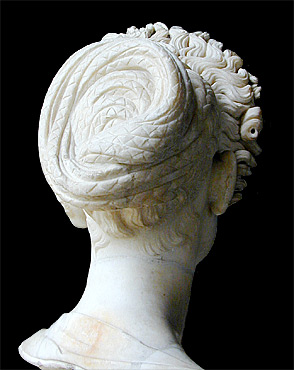
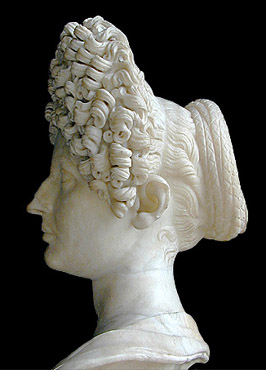
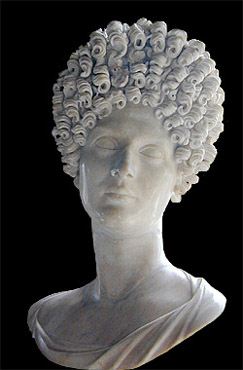
All pictures courtesy VRoma Project

From the back, this lovely hairdo would generously fill any woman's prayer cap or veil. The hair is obviously long, well kept and beautifully dressed. I wish my hair were long enough to wind around my head as many times as this matron's lovely crown.

But other views of this marble bust from the Flavian era, 69-96 CE, show just how much effort, time, pommades and slaves it took to dress hair in this manner.
 

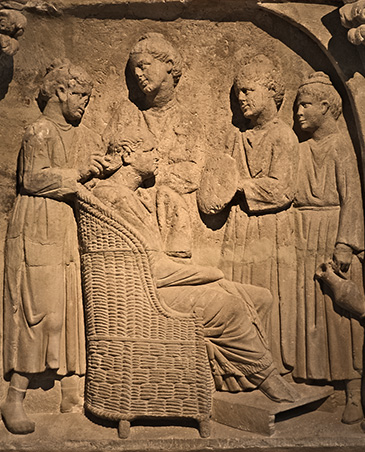
This is the broidered hair that Paul speaks about in 1 Tim 2:9. Any woman who is taking this much time for herself in her toilette has no time left for spiritual thoughts or good deeds, she is consumed by vanity. Not only is she using time that could be put to better use, she is using up the lifetimes of other women,her slave girls and dressing maids.

Sunday, December 10, 2006

Public vs Private Women

Several weeks ago a program appeared on the History Channel regarding the Civil War period of the 1860s in Nashville, TN. Prostitutes were licensed for the first time and were dubbed, "Public Women." I suppose public meant that any who chose to use them could compared to the private women men kept at home.

Last week previews for Victoria's Secret Fashion Show appeared on many channels. I was appalled by all of those private garments on public display and the almost naked bodies of the models. When I last saw a Miss America Pageant, each contestant had to appear in a one-piece bathing suit [what we consider a public garment]—those girls were fully clothed in comparison to the VS models—what a contrast in modesty.

When watching a rerun of “Coal Miner’s Daughter,” the life of Loretta Lynn, I was reminded of my high school days of the 60s where “Christian” and Mormon [LDS] girls wore jewel necklines and elbow-length sleeves on their long gowns; Miss Lynn wore those frothy, lacey and lovely “Gunny Sax” dresses—such femininity and such beauty in those long covered up dresses. Those covered girls were just as lovely as those girls in their strapless and spaghetti-strapped gowns—after all, isn’t a formal dance an acceptable place to display a little flesh? But what did all that lovely display and close dancing to romantic music [yes, it was still romantic—not acid rock and heavy metal then] lead to—how many girls of your acquaintance became pregnant on prom night? And can those escorts be castigated for succumbing to all that feminine allure—isn’t that what the VS models and prostitutes set out to do, but to lure our men into licentiousness?

All of the public display of what ought to be private makes me want to cover not only my hair but all of my body—to take a private stand against public women.

Monday, November 13, 2006

discrétion says it all -

EZEK 16:10-15 And I had you clothed with needlework, and put leather shoes on your feet, folding fair linen about you and covering you with silk. And I made you fair with ornaments and put jewels on your hands and a chain on your neck. And I put a ring in your nose and ear-rings in your ears and a beautiful crown on your head. So you were made beautiful with gold and silver; and your clothing was of the best linen and silk and needlework; your food was the best meal and honey and oil: and you were very beautiful. You were so beautiful that the story of you went out into all nations; you were completely beautiful because of my glory which I had put on you, says the Lord. But you put your faith in the fact that you were beautiful, . . .Bible in Basic English

Sometimes it's hard to think of being plain when you once considered yourself beautiful.

Good deeds are more important than good looks. The proverb was first recorded by Chaucer in 'The Wife of Bath's Tale' (c. 1387). In 1766, in the preface to 'The Vicar of Wakefield,' Oliver Goldsmith wrote: 'Handsome is that handsome does.' First attested in the United States in 'Journal of a Lady of Quality' (1774). The saying is found in varying forms, including 'Beauty is as beauty does'." From the "Random House Dictionary of Popular Proverbs and Sayings" by Gregory Y. Titelman (Random House, New York, 1996).

As a jewel of gold in a swine's snout, so is a fair [beautiful] woman which is without discretion. Prov. 11:22

discrétion f 1. (réserve, silence) discretion; ~ assurée confidentiality guaranteed 2. (sobriété) discreetness; (d'une toilette, d'un maquillage) simplicity; (des décors) unobtrusiveness; s'habiller avec ~ to dress quietly

In like manner also, that women adorn themselves in modest apparel, with shamefacedness and sobriety; not with broided hair, or gold, or pearls, or costly array; 1 Tim 2:9

Amazing how looking at another language can sometimes bring hidden meaning out. The French word discrétion says it all - Godly women will be reserved, discreet, unobtrusive, embody simplicity itself, and quietly dressed.

Sunday, October 29, 2006

USAToday on Covering

An article recently appeared in USAToday about women of many faiths beginning to cover and wear modest apparel. The gist of the piece seemed to say that there is a movement, a zeitgeist if you will, that crosses religious and cultural boundaries.

My husband used this article in a recent composition class which he teaches at a local university. The discussion brought up some interesting conclusions:
· Covering is the opposite of the slut look
· It’s an anti-Madonna [the singer] statement
· It’s a feminist statement [as in feminine but modest vs. androgynous and ugly]

Further discussion revealed that if it is, indeed, an opposite pole from looking like you’ve just crawled out of bed [some people pay a lot of money to get their tousled locks and off-shoulder looks], then one can expect to see as many women covering and dressing modestly as those who flaunt their sexuality in dress [or lack thereof] and unkempt hair.

Perusing other blogs about plain dress and comments to these posts can find even lesbians feeling the need to cover [but sadly not the need to repent] and going so far as to consider nudity as a means of “plain dress.”

I hope my husband's class discussion is right--it will be a blessing to begin seeing more modest dress and coverings as American women of all faiths begin to respond to the Spirit.

Wednesday, October 18, 2006

R E S P E C T . . .


Brittany bonnet, similar to what I wore that night.

Women who wear headcoverings are treated differently than those who don’t.

One evening in March 2001, while returning to Illinois from Old Fort Niagara, NY, I pulled off the freeway in Ohio seeking shelter from a blinding storm of lake-effect snow. I had been reenacting F&I and had delivered a lecture on French Colonial Housing at the Fort on the shore of Lake Ontario and had left the fort as the storm was approaching–I was in a hurry and had not removed my headwear, a “Brittany Bonnet,” made from a pattern purchased years before from a museum shop, one of a series of so-called French regional bonnets. My bonnet was warm and comforting and I still had the several layers of linen clothing on, as well; chemise, corset, two petticoats and a manteau-de-lit or bed jacket of cotton. I was warm and toasty and the layers were a good foil against the wind and swirling snow.

As I struggled through the lobby door to register for a room, the desk clerk looked up, and with a somewhat startled look upon his face, asked me who I worked for. At the time it was S7HD, a health department in Southern Illinois. That answer seemed to satisfy him, but he immediately asked someone from the room behind the desk to help me carry my bundles (reenactors do not carry suitcases) to my room. Now keep in mind, this was a Motel 6, and this service was out of the ordinary. When I reached my room and after I had shut the door and looked in the mirror, I realized what must have been the reason for the look on the clerk’s face–my bonnet looked like a nun’s coif–hence the “special” treatment.

Since I have begun wearing a head covering every day now, I notice that which ever man is next to me as I reach a doorway almost ‘busts his buttons’ to reach for the door first and hold it open so I may pass through. This gesture of respect did not occur, except as a rare occurrence, before I wore a covering with men other than my husband. I am thankful for the respect–I can only conclude that the sign upon my hair is responsible for this gesture.

Sunday, October 15, 2006

On Returning to Headcoverings . . .

I was raised an Episcopalian, and most every Sunday found me in church, wearing a hat and my best outfit. In my mind I remember seeing Communion celebrated about every other week, and as part of the service, the priest would chant each of the 10 Commandments and the congregation would chant back that we would/will keep them. When I was in third and fourth grade I attended a Christian school whose teachers were Quakers and whose students were mostly 1st Baptist. My brother and I were the only "heathens"--Episcopalians could smoke, drink but not get drunk, play cards, go to movies--we were definitely not like the other kids. Part of the schooling was scripture memorization and at 9, I had to memorize and recite the 10Cs. As soon as the assignment was given, I raised my hand and offered to recite them--I had already memorized them and "knew" that I kept them, including the 4th--the Sabbath. When I had finished reciting them perfectly to the Quaker teacher, Mr. Denzel Davis, I asked him if everyone still keeps the Sabbath--he said no, we kept Sunday instead. My 9-year old brain went on tilt like a pinball machine! I knew that wasn't right--that was not what I said I would do each Sunday in my mind. But it wasn't until I was 15 that I made a decision to keep the Sabbath, no matter what.

I first attended an Adventist church as it was the only one I knew of besides Jews who kept the Sabbath. After several months my family and I began attending the Church of God-7th Day, and still later that year with Herbert Armstrong's group, Radio Church of God, which became the Worldwide Church of God, and has since splintered into hundreds of competing churches and denominations and many no longer keep the Sabbath.

In August of this year I was doing some research for my husband on Anabaptists for an article he was writing and came across a site with two articles on headcovering on a Mennonite site from Montana. As I was raised in Idaho, I read them both, and immediately was convicted to seek to wear a headcovering again--not just a hat--which no one of my acquaintance had worn for at least 45+ years. I gave the articles to Homer, my husband, and asked him to read them and give me his opinion of them. This article resulted, with a small piece of my own attached at the bottom. I also started a blog regarding my plain dress and headcovering experience/journey. During the time that Homer was reading and writing the response, I was asked in the store if I were a "Frieda," a Mennonite of the acquaintance of the questioner. I told her no, but she continued that I looked like I should wear a bonnet--I now do and it's like coming home. No one in my past Sabbath-keeping faith group wears one but me [that I am currently aware of], nor is plain dress a practice. So it's back to being a pioneer again.